
Marion County Most Wanted List
Begin with the Marion County Sheriff's Office wanted list. It's the county's official spot for featured notices. Expect something small and curated. At one point it carried three entries, one already stamped "Arrested," which shows why each status deserves a fresh read. Assume nothing displayed is still active. The page doesn't promise a daily or weekly refresh. Entries and stamps change whenever the office gets to them. Photos appear on the list, but the images stay at the official source rather than getting copied around the web.
The sheriff's own warning adds limits. Addresses can be wrong. Wanted information shifts quickly. Only on-duty law enforcement can judge whether a warrant still stands when you call. Those cautions are spelled out on the Marion County wanted-list safety page.
The page pushes one clear message: verify with the office, report safely, and let the courts do the deciding.
Marion County Wanted Listing Fields
A single wanted record can hold more detail than the main list shows. Fields shift from entry to entry. So a blank space means nothing either way. Treat the listing as an agency notice tied to a reported offense and warrant, not a finished court file.
| Field | What the Marion County listing may show |
|---|---|
| Name and photograph | The displayed identity and sheriff-published image used for recognition. |
| Alleged offense | The offense or offenses associated with the wanted notice, not a conviction. |
| Bond | A listed bond amount or status when entered by the agency. |
| Physical description | Sex, date of birth, hair, eyes, height, weight, and race where supplied. |
| Status and contact | An update such as “Arrested,” plus instructions for sending information. |
| Printable poster | A sheriff-hosted version of the notice for official public-awareness use. |
Don't lean on the photo as biometric proof. Don't bookmark an old detail URL as a live status feed. Match the name and description first. Then let law enforcement confirm both the identity and the current warrant.
Using Marion County Fugitive Notices
The right way to use a fugitive notice is simple. Read the official entry. Pass along anything useful you actually saw. You never need to contact the listed person yourself.
- Open the sheriff's current wanted list and accept the official disclaimer. Avoid cached search results and saved posters when a live entry is available.
- Read the displayed status, alleged offense, description, and contact direction. Remember that an “Arrested” stamp can remain visible during a status transition.
- If recognition is uncertain, do not make a public charge. Note only facts that can be reported safely, such as a location, time, vehicle, or direction of travel.
- Use 911 for an emergency. Otherwise call the sheriff or use the official crime-tip form without approaching or alerting the person.
- For a custody follow-up after a reported arrest, consult the Marion County booking and roster channels. A booking record is still an intake record, not a conviction.
The official list moves faster than the copies search engines keep. A missing listing proves little, too. The page features selected notices, not the sheriff's full warrant inventory.
Note: A listing records a law-enforcement request for information, nothing more.
Marion County Warrant Check by Phone
For a full Marion County warrant check, skip the wanted page and pick up the phone. The Sheriff's Office warrant FAQ notes the office holds thousands of warrants issued through District Court and Circuit Court. It treats those records as public under the Arkansas Freedom of Information Act. No complete name-search warrant portal exists for the county. The call is the route. Staff can give you the warrant date, the charge or charges, the bond amount, and the issuing court. That applies whether you're asking about yourself or someone else. The non-emergency line runs around the clock. Only on-duty personnel can confirm a warrant's present validity. A roster result, a court docket, an old city PDF, or a vanished wanted entry is no substitute. Check the live warrant and records FAQ before calling, in case the process has shifted.
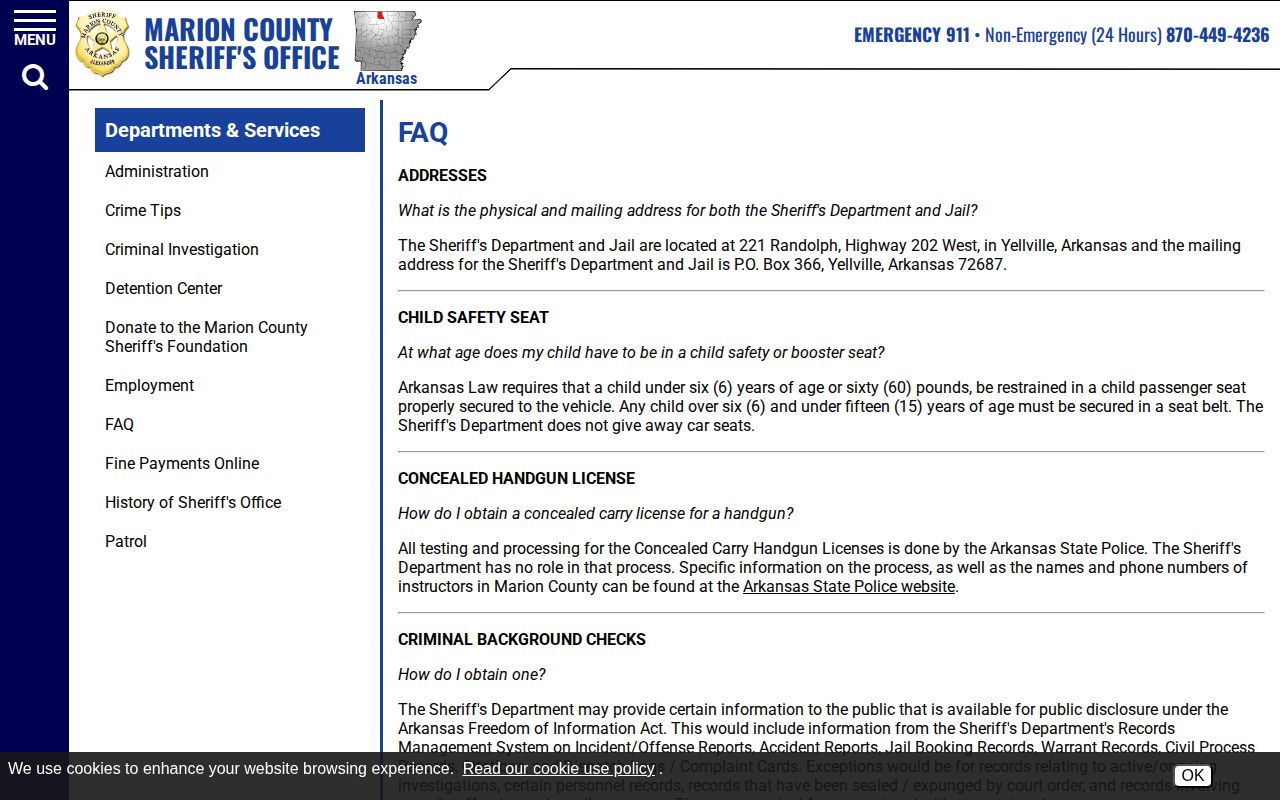
The page lets staff confirm warrants directly, and it keeps that function separate from the small photo-driven wanted list.
- Gather the person's full name and any other lawful identifying detail that can prevent a wrong-person match.
- Call the Marion County Sheriff's Office non-emergency line and state that the request concerns warrant confirmation.
- Ask for the warrant date, alleged charge, bond status, and issuing court. Write down the court name because it determines the next official contact.
- If the warrant may concern the caller, contact an attorney or the issuing court for lawful help resolving it. Follow direct official instructions and do not rely on web-page status alone.
- Use Search ARCourts or the court clerk to follow later filings and disposition, understanding that a docket does not confirm live enforceability.
Marion County Warrant Types and Courts
Warrant types split along the issuing court and the bond direction. That much holds up. What doesn't is predicting legal outcomes from those labels. The sheriff can tell you what its record says. The issuing court or an attorney handles what comes next.
| Warrant record detail | What it means for the check | Best confirmation path |
|---|---|---|
| District Court warrant | Issued through the court that handles countywide misdemeanors and preliminary felony matters. | Sheriff for live validity, then the named district court. |
| Circuit Court warrant | Issued through the court responsible for felony criminal cases and other circuit matters. | Sheriff for live validity, then Circuit Court or the Circuit Clerk. |
| Bond specified | The warrant record contains a court-set bond amount. | Confirm the current figure and instructions with law enforcement or the court. |
| No Bond | The FAQ says the person remains in custody until appearing before a judge. | Seek attorney or court guidance and follow official directions. |
An old Bull Shoals warrant PDF, dated years back, is not a current county check. A court filing can show a warrant once issued without proving it still runs today. Those dead ends point to one thing. The live call to the sheriff is the core Marion County step.
Marion County Fugitive Tips
Tips reach the sheriff two ways. Use the non-emergency phone or an official multimedia form. The form takes a message, an optional email address, and files such as photos, video, or audio. That optional email carries no formal anonymity promise. No Crime Stoppers reward program or reward offer could be confirmed locally, so don't count on either.
Marion County Sheriff's Office
221 Randolph
Yellville, AR 72687
Non-emergency, 24 hours: 870-449-4236
Official crime-tip form
Emergency: 911
The form warns that ordinary email is not encrypted and should not carry confidential, sensitive, or personal information. Call the office when the information is sensitive. A useful report sticks to firsthand observations and avoids speculation, social-media accusations, or attempts to investigate.
Note: The Marion County form accepts media files, but the sheriff does not promise anonymity, confidentiality, or a financial reward.
Resolve a Marion County Warrant Safely
Suspect a warrant has your name on it? Work from confirmation toward lawful resolution. Do not read meaning into a wanted-page omission. The sheriff's FAQ names voluntary surrender as one way a warrant gets served. It also tells anyone with questions about an active warrant to contact the office directly. That points to a careful path. It does not lock in a set schedule or a fixed set of intake steps.
First, confirm the warrant with on-duty staff. Write down the issuing court, the charge, and the bond status. Bring in an attorney early, since a lawyer can explain rights and deal with the court on your behalf. The issuing District Court or Circuit Court handles its own process. The sheriff can give current agency directions. If voluntary surrender is your route, get the instructions straight from the Sheriff's Office. Skip the social posts, stale PDFs, and any unofficial advice.
No online article can forecast bond, an appearance date, or how a charge resolves. A "No Bond" entry simply means the FAQ expects custody to hold until a judicial appearance. Keep the sheriff, the court, and your attorney in their separate lanes. That is what keeps the response safe and accurate.
Marion County Listings and Innocence
A wanted notice begins with an allegation and a judicial command. It is not a verdict. Charges may later be amended, reduced, dismissed, or resolved after a plea or trial. Even an arrest and booking only show that the detention system recorded an intake event. The final account belongs in the court record.
Custody states also differ. The wanted page may describe someone not yet taken into custody, though an “Arrested” stamp can remain for a time. A warrant check addresses judicial process whether or not the person is jailed. The current roster concerns present detention-center custody, while the rolling feeds concern recent booking or release. Reading each source within that narrow purpose prevents a wanted listing from being mistaken for proof of guilt.
Marion County Wanted Updates Online
Social media spreads the word fast. Treat it as a backup channel, though. The sheriff's Facebook, Instagram, and press pages amplify selected wanted notices, arrests, and public-safety updates. A post can travel far in a hurry. Just remember the limits. Posts get edited, delayed, or pulled without warning. No recurring Marion County "Warrant Wednesday" feature checks out either. For anything that matters, the live wanted page and a phone call to the sheriff still beat a social post every time.
RPS-Inmate Info trips up a lot of people. It is a multi-agency vendor app linked from the roster. Pick the right agency and it can show inmate photos, booking details, arrest or release data, charges, bond, and court information. What it does not offer is Marion County warrant alerts or a most-wanted service. Someone featured on a wanted page who later lands in jail may appear in that custody view. That is useful, but the app speaks only to detention status, nothing beyond it.